
Bite Inhibition definition: A Carnivores ability to control the force of bites especially in social situations. When puppies or kittens play with their siblings & the offender bites a sibling with their sharp needle like teeth the sibling yelps & stops playing. This teaches the offender to play more gently. Sadly some puppies or kittens are placed in their new homes at 4-7 weeks & were too young to really learn from their siblings about bite Inhibition. This usually occurs at about 8-10 weeks of age. There are also occasions where there were no surviving siblings, so the mom has to teach this, but her teeth are not as sharp, so not all single puppies or kittens learn this way.

The kitten in the photo above was an orphan that I took in many years ago when it was about 10 days old. It was after it was presumed that a dog killed the mom & the rest of the litter. My boyfriend at the time lived with the dog’s owner & they found this kitten alone in the garage or shed on the property. My sister Karen & I shared the responsibility of hand feeding the kitten. She didn’t have any siblings & our cats at the time all hated the kitten, so we didn’t let them interact with her. As she grew she was a biter & her teeth were very sharp. She loved to play, so we would redirect her from biting with toys or time outs, meaning we ended the play time to let her figure out that if she bit the play ended, like her siblings would have done had she had any at that time.
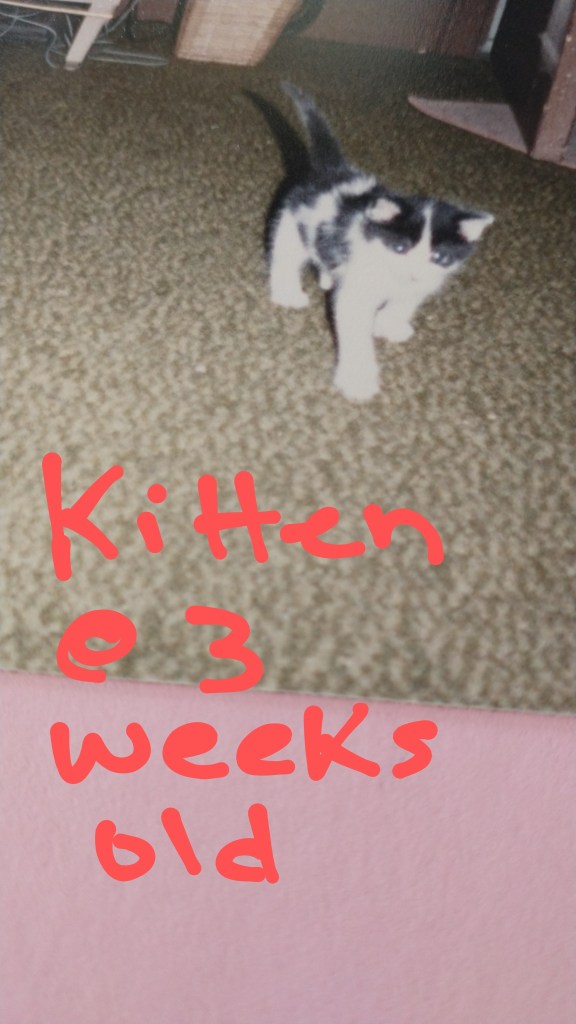
When she was weaned & ready for a new home she was adopted out to a family with two kids & they were all willing to work with her & help teach her not to bite.

The puppy above is Tallulah she is a new Pittie pup to some friends who live in FL. She is about 14 weeks old. At about 16-18 weeks old bite inhibition usually is understood by most puppies.
If you have a pup that came into your home before it was 8-10 weeks old & didn’t learn bite inhibition, there are things you can do to help teach your puppy. Always use positive reinforcement, you don’t want to break the trust your puppy has in you now or in the future. I will give you a few suggestions to try with your puppy, if under 18 weeks most learn these quite quickly as long as you are consistent. If you’re not consistent then you confuse the pup & it won’t get what your trying to teach it. This goes for guests & all family members, if they don’t follow the rules put the pup away when that person is visiting your home. It is harder to undo a behavior or habit than to teach a new one. Be patient & remember animals don’t speak or understand the human language like we do.
- When your puppy bites your hand try giving the puppy something appropriate to chew on like a chew toy like these: https://amzn.to/3ESCWkj https://amzn.to/3YthLfn
- When your puppy bites your hand: screech “ouch” in a sharp loud high pitched voice & get up & leave the puppy. I suggest you do this near a doorway where you can have a baby gate https://amzn.to/433SxFO right behind you. You can step over the gate & still be able to watch the puppy. Give him or her about 2 mins & then step back over & try again. While you’re away be sure there is something for your pup to chew on such as a toy or chew like these: https://amzn.to/3Ytie17 https://amzn.to/44QTX92 When you return, try again & if puppy bites again repeat, but this time leave for 5 mins. Don’t hand the puppy the toy or chew as you don’t want your pup to associate you leaving with a reward, just be sure it is close by so he can see it & get it himself. Animals (& humans) repeat what gets rewarded, so if they play nice you stay, but if they bite you leave.
- Have your puppy have play dates with other puppies close to his or her age, maybe even its siblings if possible. You want to be sure these are all healthy puppies before your young pup plays with any other dogs or puppies. They seem to learn better from other pups with sharp teeth like theirs.
Remember they repeat what they rehearse & it gets imprinted, so be patient, consistent & remember our pets want to interact with us & to please us. So when they bite its GAME OVER, wait & try again, give them a chance to figure out what you want from them.
If you have an adolescent dog who wasn’t taught bite inhibition & he or she is now older than 18 weeks & much bigger & bites or nips hurt more. Some stuff out there says you are too far beyond teaching bite inhibition, but I don’t believe this is true. The pup Alex showed above is the first & only young pup I ever fostered, so most of my fosters were over 6 months old & many didn’t know much at all when they came to me. Is teaching an adolescent dog bite inhibition hard work? yes it is, & it’s going to be a lot of work. You need to control who is meeting your dog & tell them your rules before they actually greet your dog. Let them know we are teaching him to be gentle & he can be mouthy (don’t use the words bite inhibition-or all they may hear is ‘bite’ & think you have a dangerous dog). Ask them if they feel his mouth on them to move away & turn away “Game over.” 5 mins & try again, if they feel his mouth then again, game over again. I would try this no more than 3-4 times at a session. I would recommend you find someone who is dog savoy that you can trust to help you practice with your dog. If you have several people to help at different times that is even better. More practice the better. If you are doing this at your home, use a baby gate, so you can step over it or walk thru it if you have the swing type gate which is what I like to use. https://amzn.to/4jF0jwZ

I hope this has given you a couple ideas of ways to help your new puppy or young dog learn bite inhibition. If you are learning from or even just enjoying my blog post please consider subscribing to it. (you won’t get spam, just a notice when I publish a new post). Likes, sharing on your social media sites & sharing this with friends & family help to get the word out there about my blog. I like reading your comments so please share them with me, if you have suggestions of topics share them as well. Please visit often. There is a table of content on the home page, upper left corner, click on the 3 bars. Thank you, Debbie My email is: echoinggreatpetcare@gmail.com
 Echoing Great Pet Care