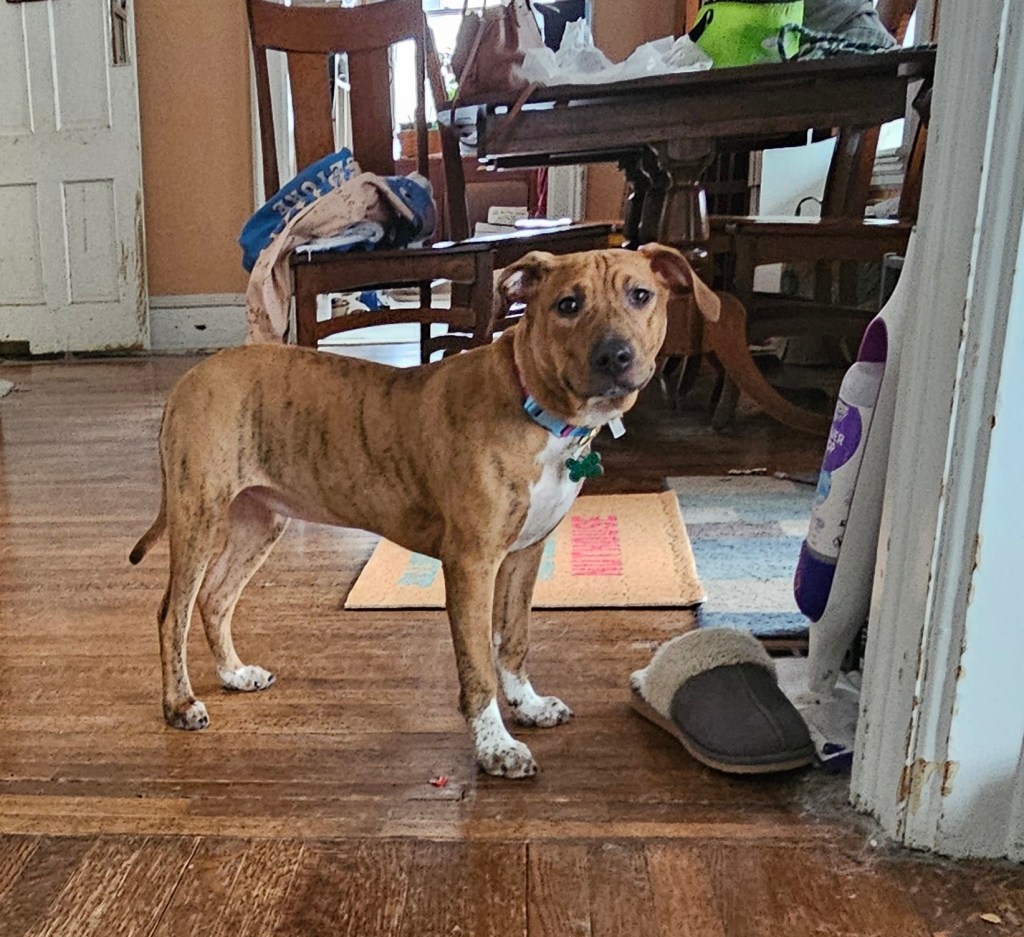
As humans we sometimes assume our pets should know what is appropriate to chew on (their toys) & not our slippers or other things. The puppy above is a new dog for one of my co-workers, she is estimated to be 5-6 months & may never have had a family of her own before to teach & guide her so she knows what is good behavior. Gracie was a rescue dog & I am familiar with the rescue she came from & a lot of the dogs they rescue lived outside. The area where they are from is more rural & dogs are not often unaltered nor are they house pets. Many sadly live outside & some just run free & not kenneled or leashed. This is sad, but its a good thing rescues can help the overburdened shelters there & take in some dogs.
So please don’t assume dogs have a clue what is appropriate & safe to chew on. The trainer I used when I got my first dog as an adult & living in my own house (fully my responsibility) said something to me that has stuck. My dog Sam had chewed on several of my things including my shoes, so during question time (think on orientation night) I asked about this. Pat asked me a few questions: she said Where are your dogs dishes? Where are his toys? Where is his dog bed/crate? I said on the floor & then she asked where were your shoes? My answer was “on the floor.” Her point was ‘how was Sam supposed to know my shoes weren’t toys for him’. Honestly I hadn’t thought about it from my dogs perspective.
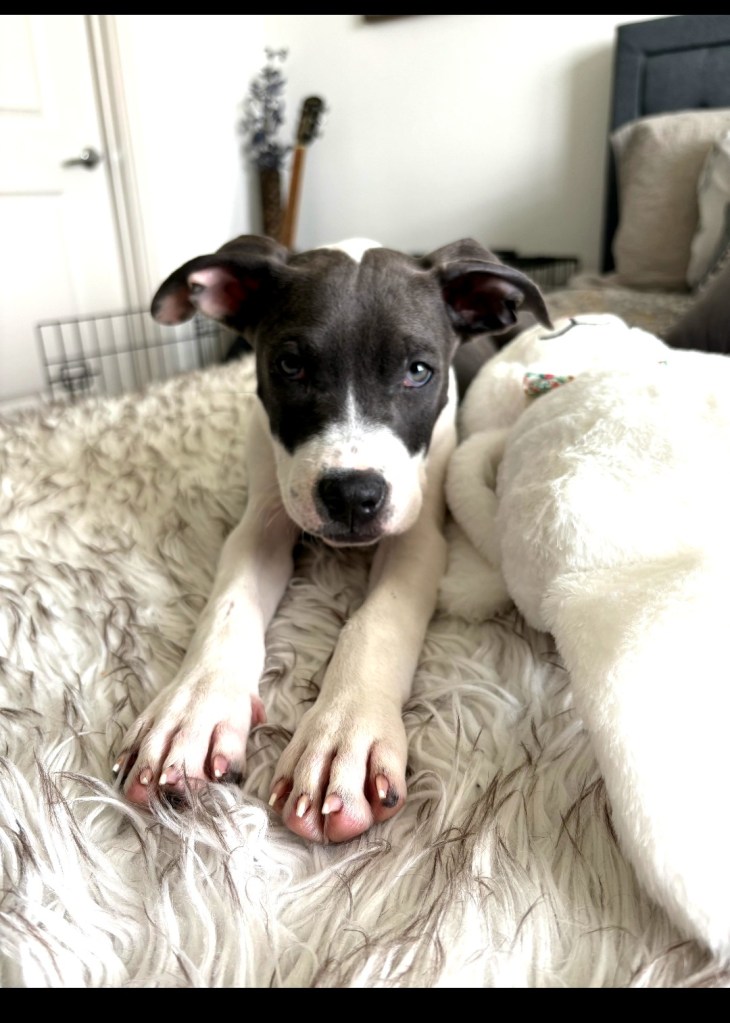
Whether your dog is a new puppy or a year old dog we shouldn’t assume they know much of what we as humans want or expect without properly & gently teaching them. Puppies chew a lot, they are getting in teeth & like human babies they feel texture & sensations through their mouths, so they are learning & experiencing new things this way. Dogs don’t have hands, so to pick up any thing it has to be with their teeth.
With many dogs till they hit about 18 months old they may still go through chewing stages. I had a coworker years ago that had a Boxer & he was I think about 10 months old (maybe a little older) & he had been so good she decided to leave him out of his crate for a few hours when she left for work. Her boyfriend would be there in about 3-4 hours. A few hours later she gets a text from her boyfriend & I heard her gasp. I of course asked what was wrong & she turned her phone to show me. It looked like a screen of mostly snow at first, & I was confused it wasn’t registering. She tells me that was their brand knew sofa, their adorable Boxer had completely destroyed in it a few hours out of his crate. This is a big part of why I always recommend crating or using an exercise pen, or gating off a pet when left home alone till at least 2 years of age. Both my dogs have separation anxiety so they will most likely be crated for life when no one is home. Their crates are a safe spot & that is how a crate should be. I wrote about crating, it is blog post #6.
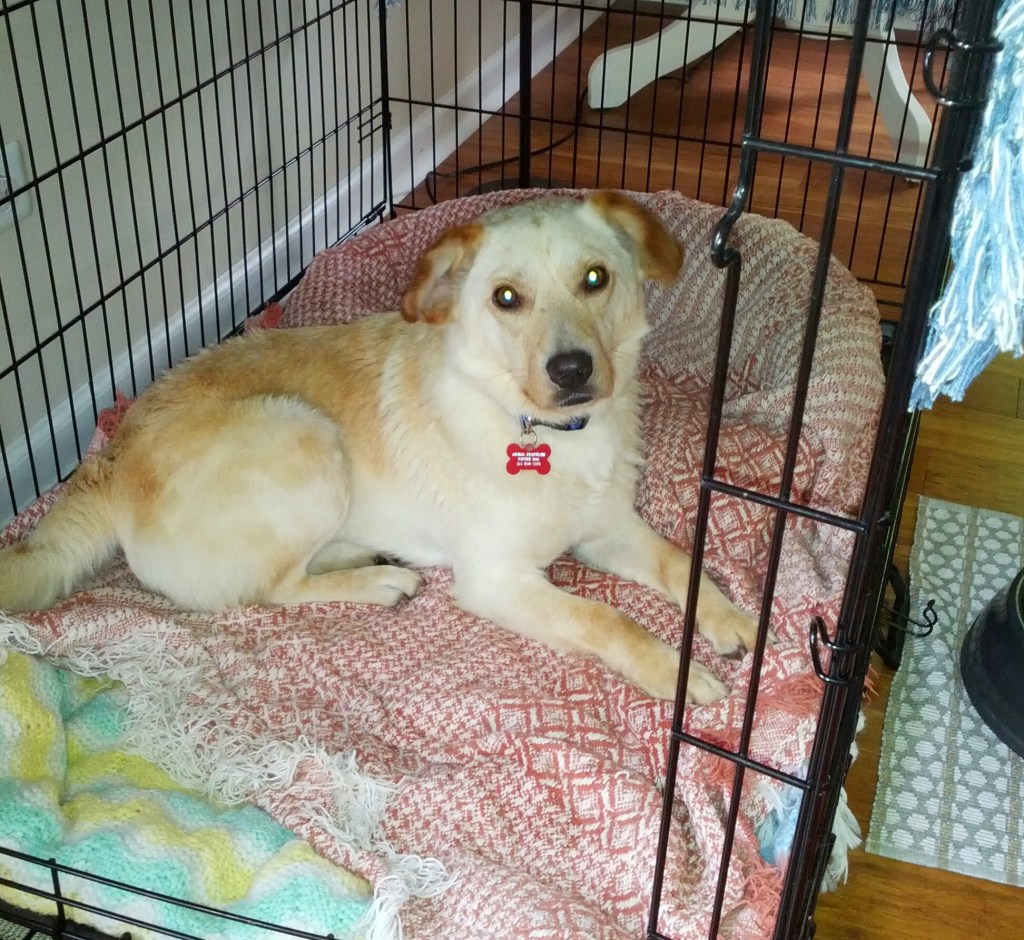
Somethings you can do to help with inappropriate chewing are:
- Don’t set your pet up to fail, remove things from where they have access to them, put up high, behind baby gates, behind closed doors or cabinets. You may need to temporarily get some plastic type totes & put items in them.
- If chewing on cords use deter sprays such as “Bitter Apple” or similar sprays made to deter pets from chewing.
- Use a crate when you can’t be home to monitor.
- Use an exercise pen (similar to the concept of a playpen for a toddler) or baby gates to limit access to all areas.
- Have lots of chew toys & items for your dog to play with. Leave some on the floor in anyplace your dog is allowed. You can always pick them up if your having company over. I am a believer in taking your dog to a pet store with you & letting them pick out toys they enjoy. It gives you an idea of what that particular dog likes.
- Teach your dog to “drop it” which means releasing it from their mouth & allowing you to get the item. ALWAYS replace it with an appropriate pet chew/play item. I suggest you have a couple very special items kept out of reach of your dog that maybe squeaky ones & you can offer it to get your dog to drop the inappropriate item they have gotten hold of. If they aren’t given something better, why would they give up your awesome slipper they are chewing on. Know which items are high value to your pet because a low value item won’t be worth the exchange.
- Teach your dog to “leave it” this means your dog sees an item of interest, but hasn’t touched it yet & when you say ‘leave it’ they don’t touch the item. You again need to reward this behavior because that wasn’t always easy to resist that temping item you accidentally left where they could get to it.
- If your dog isn’t good about giving up items you can attach a light weight clothesline to their collar (buy a light weight hook for the collar attachment part) & let them drag the leash around with them. One that is 8-10 feet should be plenty, you can start longer & cut it or vice versa. You can use a leash for this, but it your dog chews a leashes that is a lot more $ lost then an inexpensive cloth cloth-line. This is only for when you are around to monitor them so it doesn’t get caught on anything. If your dog is chewing on something inappropriate you can simply go over & pick up the leash & gently move your dog away from the item. Be sure & lead them to an appropriate chew item or reward with a treat. The dog can’t take a treat & not drop the inappropriate item at the same time. You can show the treat & toss it so you can get the inappropriate item while the dog eats the treat.
Dogs are usually the pet that most people think about chewing on inappropriate thing but rabbits, guinea pigs & birds can also sometimes do this. Managing their environment is the way to prevent this, gates, pens, cages & number one is monitoring them. My larger Parrots have their own room, they are not tame but the room is a place where they can at times (when someone is home) have time out of their cages to climb around, play & interact with each other. I have toys that hang from the ceiling & there are a couple empty cages in the room that have toys attached so they have a variety of things to chew on. They enjoy going into each other’s cage & all these things prevent boredom, so they are less likely to chew on inappropriate things. I also have some empty cardboard boxes around that they enjoy chewing on or going in.
I hope this post has helped by giving you some ideas of things to try if your current pet or a future pet chews on inappropriate items. I write this blog to help pet owners by educating & giving ideas to help their pets not just survive but thrive. You can help me spread the word about my blog a number of ways. Liking posts, commenting, subscribing,& visiting often, all these help me to get farther up on search engines, then more people can find my blog. Sharing my blog on your social media platforms also helps others to see it. I am an animal lover & enjoy sharing my 20+ years fostering a variety of pets & owning a variety as well. Thank you for visiting & reading this post, I have written 105 other posts & you can find the table of content of these on my home page, under the show link in the upper left corner. From the home page you can scroll down & read the posts. Hope you will be back soon. Debbie
 Echoing Great Pet Care